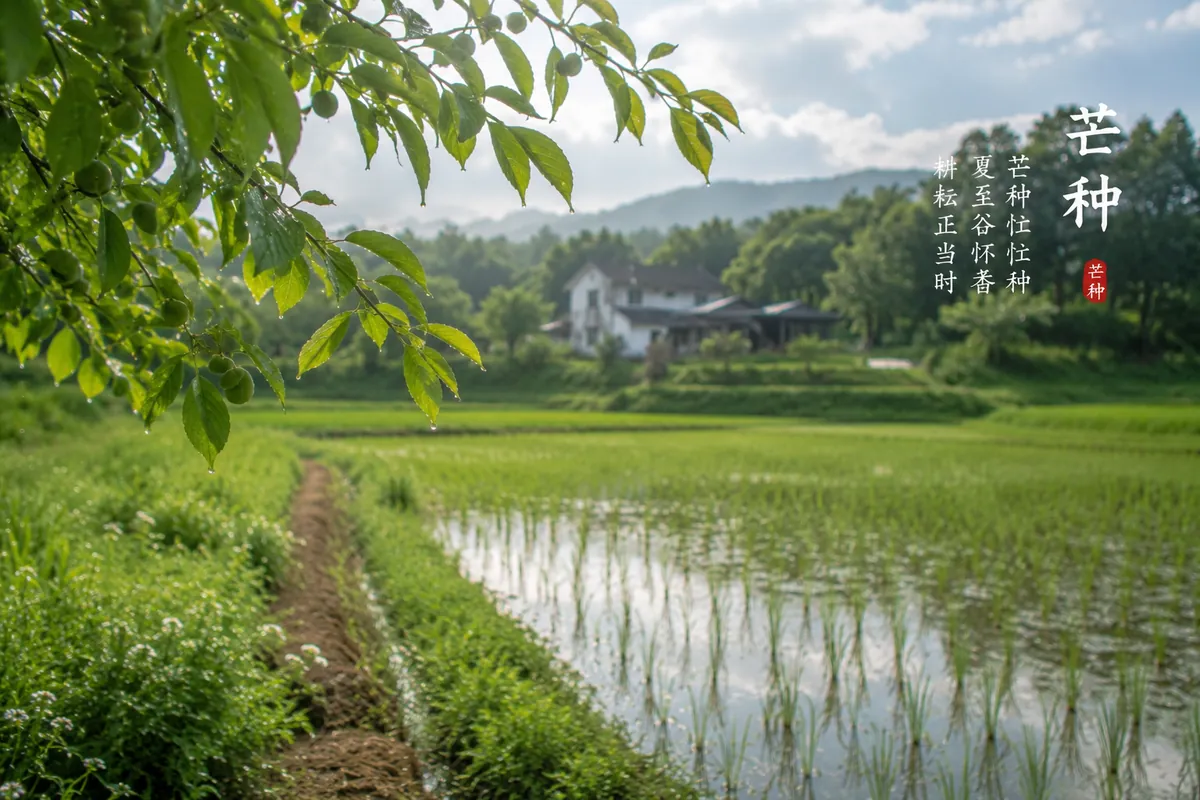
By early June, the Chinese countryside is in a frenzy. Wheat turns golden and heavy. Rice seedlings need to go into the flooded paddies — now, or they'll miss their window. And above it all, the air turns thick with the particular heat of a Chinese summer: warm, wet, close.
This is 芒种 (Mángzhòng) — Grain in Ear — the 9th of the 24 Solar Terms. It falls around June 6th each year, and its name carries both halves of the season in a single breath: 芒 (máng), the bristled awn that appears on ripe wheat and barley, and 种 (zhòng), the act of sowing. Harvest the old. Plant the new. Do both at once. And do it fast — because after 芒种, the window closes.
For Traditional Chinese Medicine, this is far more than a farming calendar note.
🔥 The Fire and the Flood: TCM's View of Early Summer
In Traditional Chinese Medicine, summer belongs to the Fire element, which governs the Heart and Small Intestine. The Heart is considered the "Emperor" of all organs — housing the Shen (spirit, consciousness), governing blood circulation, and keeping the mind clear and steady. When the Heart is at ease, you sleep soundly, think clearly, and feel a warm, stable joy.
But 芒种 brings a particular challenge: it's not just hot. It's damp-hot (暑湿, shǔ shī). As summer humidity rises alongside the heat, a thick, heavy quality settles into the atmosphere — and, according to TCM, into the body too. Damp-heat is one of the six pathogenic factors practitioners watch most carefully in June and July.
The dampness is the part most people in the West don't expect. It doesn't announce itself dramatically. Instead, it creeps in as sluggishness after meals, a heavy feeling in the limbs, mild brain fog, or a sticky coating on the tongue. These are all signs, in TCM terms, that the Spleen — your body's main dampness-regulator — is under strain.
So during 芒种, you're managing two things at once: protecting your Heart from summer heat, and protecting your Spleen from dampness. Fortunately, TCM has been thinking about this for centuries.
🍽 What to Eat in Grain-in-Ear Season
The flavour TCM associates with the Heart — and with summer heat — is bitter. Not harshly bitter; gently bitter, like a cup of good green tea or a square of dark chocolate. Bitter foods are thought to "drain downward," carrying excess heat away from the upper body and supporting the Heart.
- Bitter melon (苦瓜) — the most iconic summer bitter food in Chinese cuisine. Stir-fried with egg or tofu, it's milder than you'd expect. In TCM, it's a classic tool for clearing summer heat from the body.
- Lotus leaf tea (荷叶茶) — cooling, slightly bitter, traditionally sipped through summer. It gently supports the Spleen while helping to clear heat.
- Mung beans (绿豆) — the go-to TCM food for hot days. Mung bean soup (绿豆汤), served at room temperature, has been China's summer tonic for generations.
- Job's tears / barley (薏米) — excellent for draining dampness from the Spleen. Paired with red adzuki beans (赤小豆), this combination appears in soups, congee, and drinks across China all summer long.
- Cucumber (黄瓜) — cooling, hydrating, and easy on the digestion. One of summer's simplest pleasures in TCM terms.
- Watermelon (西瓜) — summer's most beloved cooling food. TCM categorises it as cold in nature — best enjoyed at room temperature rather than straight from the fridge, to avoid shocking the Spleen.
And a few things to ease up on:
- Ice-cold drinks and frozen foods — they shock the Spleen and weaken its ability to process dampness, leaving you more sluggish, not less.
- Greasy, fried, or very sweet foods — these feed dampness and burden digestion at a time when your Spleen is already working harder than usual.
- Heavy, rich meals — keep portions moderate and dishes light. Your Spleen will notice the difference by mid-afternoon.
🌿 How to Live During 芒种
Rise with the sun — but rest at noon. One of TCM's most enduring summer recommendations is the midday rest (午睡, wǔ shuì). Between 11am and 1pm, Heart energy peaks and then begins its natural descent. A short rest of 20–30 minutes protects the Heart and helps the body manage summer heat. This practice has been part of traditional Chinese daily life for centuries — and modern research on napping tends to agree with it.
Exercise gently, and at the right time. Morning and evening are ideal for movement during 芒种 — gentle Tai Chi, Qigong, or a slow walk when the air is cooler. In TCM, excessive sweating in summer directly depletes Heart Qi, since the Heart governs sweat. Save the intense workouts for other seasons.
Protect your emotional world. Perhaps the most unexpected piece of TCM summer wisdom: the Heart is sensitive not just to heat, but to emotional extremes — excessive excitement, anxiety, or frustration. This doesn't mean don't feel things. It means cultivate a steady, warm contentment over frantic highs. A calm Heart is a resilient one.
Dress and live lightly. Light colours, breathable natural fabrics (linen, cotton), and good ventilation all help the body regulate temperature. Avoid sitting directly under strong air conditioning — cold air hitting warm pores is considered in TCM to be an invitation for pathogenic cold to enter the body. Fresh air over refrigerated air, whenever possible.
🏡 The Traditions of 芒种
One of the loveliest customs associated with 芒种 comes from the Jiangnan region of China: the 送花神 (Sòng Huā Shén) — the Farewell to the Flower Spirits. As 芒种 marks the end of the main flowering season, young women would go out at dawn to tie silk ribbons, coloured threads, and small blossoms to the branches of trees and garden walls — a gentle, poetic goodbye to the spirits who had tended the spring flowers. This custom is immortalised in Chinese literature, most memorably in Dream of the Red Chamber, where Lin Daiyu's famous flower burial takes place in this spirit.
芒种 also often falls close to the Dragon Boat Festival (端午节, Duānwǔ jié) — the 5th day of the 5th lunar month. The festival's traditional foods, particularly zongzi (粽子), sticky rice parcels wrapped in bamboo leaves, are thought to ward off summer heat and dampness. The overlap between the two is not a coincidence: both mark the same urgent, alive moment of early summer.
And above all, 芒种 is a season of action. The ancient agricultural phrase captures it perfectly: "三夏大忙" — the great three-summer rush, when farmers harvest wheat, plant rice, and manage summer crops simultaneously. In a culture built on the rhythms of the land, 芒种 is not a moment for pause. It's a moment to move, to plant, to act before the window closes.
Perhaps that's the real lesson for modern life too: some opportunities have a season. 芒种 is simply the calendar's way of reminding us.
📚 Further Reading
- Summer in Traditional Chinese Medicine – A Season for the Heart
- 立夏 – Beginning of Summer, the 7th Solar Term
- Cold Three-Shred Salad – A TCM Summer Classic
- Ginger – TCM's Warming Superfood
This article is part of the 24 Solar Terms series, exploring the traditional Chinese calendar and its wisdom for modern living.