The first time you rinse black glutinous rice and watch the water turn a deep, inky purple, you might think something has gone wrong. It hasn't. That colour is the whole point.
That startling purple comes from one of the densest concentrations of plant pigments found in any grain — anthocyanins, the same family of compounds that gives blueberries and red cabbage their colour, but here in extraordinary quantities. In East and Southeast Asia, this grain has been considered a tonic food for over two thousand years. The rest of the world is only just catching up.
💡 Who Traditionally Includes Black Glutinous Rice in Their Diet?
In Traditional Chinese Medicine, black glutinous rice (黑糯米, Hēi Nuò Mǐ) is associated with a pattern known as Blood deficiency (血虚, xuè xū). This is a TCM concept — not the same as clinical iron-deficiency anaemia, and not a medical diagnosis. It describes a broader state where the body's circulating nourishment is running thin, and the body begins sending quiet signals.
People who have traditionally been encouraged to build black glutinous rice into their regular diet often describe some of the following experiences:
- A fatigue that sleep doesn't fully restore — A deep tiredness that remains even after a full night's rest, which TCM associates with Blood being too thin to replenish fully during sleep.
- Pale or sallow skin — In TCM, the face reflects the quality and abundance of Blood. When Blood is insufficient, the natural warmth and rosiness fade.
- Cold hands and feet, or an easy susceptibility to feeling cold — TCM holds that Blood carries warmth through the body; when it is thin, peripheral warmth suffers first.
- A dull, persistent ache in the lower back — The Kidneys, in TCM's view, govern the lower back and knees. Black glutinous rice — a dark grain entering the Kidney meridian — has been used in this context for centuries.
- Light or irregular menstrual cycles in women — TCM classically links Blood deficiency with disrupted menstrual rhythm. Black glutinous rice congee (黑糯米粥) has long been a staple postpartum and restorative food for women in China.
- Difficulty concentrating, or a vague sense of mental haziness — In TCM, the Heart and Mind depend on Blood for clarity and calm. When Blood is thin, focus becomes elusive.
Black glutinous rice is not a treatment, and including it in your diet cannot address any medical condition. What it is — in TCM's long tradition of food-medicine — is a deeply nourishing grain that supports the body's deeper reserves when eaten consistently over time. If you recognise yourself in several of the above descriptions, speaking with a qualified TCM practitioner or doctor is always the most useful next step.
🌿 The TCM Perspective: The Black Grain That Nourishes the Root
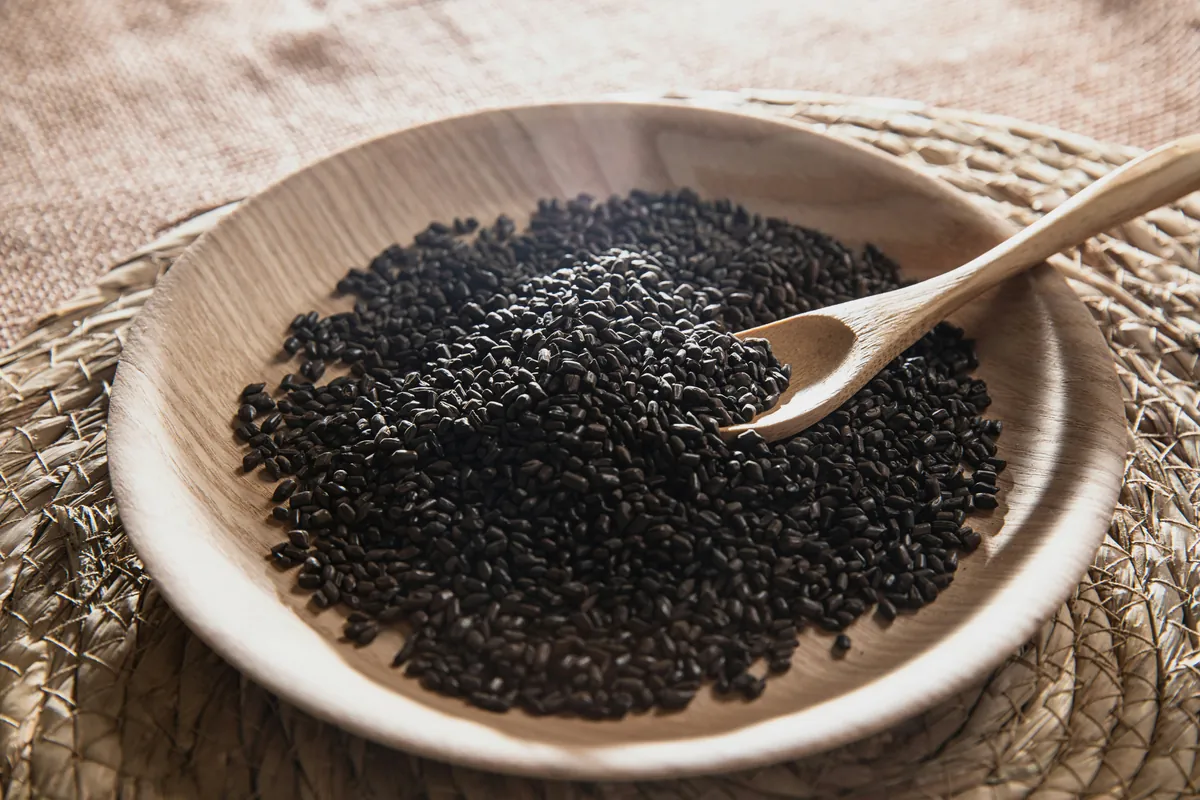
In TCM's Five Element framework, each organ system corresponds to a season, a flavour — and a colour. The Kidneys belong to Winter and to the colour black. This is not poetic coincidence; it is an ancient observational system that cross-referenced the natural world with the body over centuries. And it is why black foods — black sesame, black beans, dark mulberries — have long been valued as Kidney tonics in Chinese dietary medicine.
Black glutinous rice sits at the heart of this tradition. Its dark bran layer, which gives the grain its striking colour, also makes it nutritionally far richer than its polished white cousin. Unlike white rice, which has had its bran milled away, black glutinous rice retains concentrated stores of iron, zinc, fibre, and vitamin B complexes — as well as those remarkable anthocyanin pigments.[1][3] This is a grain that has stayed whole for a reason.
The Ming Dynasty physician Li Shizhen documented black rice in the Bencao Gangmu (本草纲目, Compendium of Materia Medica, 1596), writing: "黑米补益脾胃,滋养肝肾,明目活血,润肤乌发" — "Black rice nourishes the Spleen and Stomach, enriches the Liver and Kidneys, brightens the eyes, invigorates the Blood, moistens the skin and darkens the hair." This reflects TCM tradition, not a scientific claim — but it speaks to how thoroughly this grain was observed and trusted across centuries of daily use.
The later Bencao Bei Yao (本草备要, Essentials of Materia Medica, Wang Ang, 1694) further emphasised black rice's Blood-enriching (补血) functions, particularly recommending it for women, the elderly, and those recovering from illness or childbirth. Both texts classify it as a mild food-medicine (食药两用, shí yào liǎng yòng) — gentle enough for daily use, nourishing enough to be genuinely restorative.
TCM profile at a glance:
- Flavour: Sweet — nourishing and harmonising; gentle on the Spleen and Stomach
- Nature: Neutral to slightly warming — suited to a wide range of constitutions
- Organ systems entered: Spleen, Stomach, Kidney, Liver
- Traditional role: Nourishes Blood (补血, bǔ xuè), tonifies the Kidneys (补肾, bǔ shèn), warms the Middle Jiao (温中, wēn zhōng), and benefits the Spleen and Stomach (益脾胃, yì pí wèi) — traditionally included in diets aimed at supporting deep nourishment, postpartum recovery, and long-term vitality
🥣 How to Use Black Glutinous Rice
Black glutinous rice is genuinely, deeply delicious. It cooks to a soft, sticky, slightly chewy texture with a subtle earthy sweetness, and its deep purple hue transforms everything it touches — turning a plain congee into something dramatic, staining a sweet porridge the most beautiful shade of violet. This is a food that earns its place at the table on flavour alone.
In Chinese cooking, it appears most naturally in congee (粥, zhōu) — the long-simmered rice porridge that is China's great comfort food. Black glutinous rice congee, often made with red dates and a little rock sugar, is one of the gentlest and most restorative breakfasts in Chinese cuisine. It is also enjoyed as a sweet dessert porridge, sometimes enriched with coconut milk and paired with taro or lotus seeds, particularly in Southern Chinese and Southeast Asian traditions. In soups and tonic broths, a small handful added to chicken or pork bone broth lends colour, body, and depth.
For a congee that pairs this grain's nourishing qualities with complementary ingredients, the Goji Berry Congee on this site is a beautiful starting point — goji berry, like black glutinous rice, is a classic TCM Blood and Kidney tonic, and the two are natural companions.
A Note on Quantity and Caution
A practical daily serving is 30–50 g of dry grain (roughly 2–4 tablespoons), which yields a generous bowl of congee or a substantial side portion. As with all tonic foods in TCM, consistency over weeks and months matters far more than quantity on any single day. There is no benefit to eating a large amount infrequently — the tradition is small, regular, and patient.
A few honest cautions:
- Glutinous rice and digestion — All glutinous (sticky) rice varieties are considered harder to digest than regular rice in both TCM and nutritional terms. Those with weak digestive systems, a tendency to bloating, or a TCM diagnosis of Spleen Dampness should eat it in modest amounts and always well-cooked. Adding digestive warming spices like ginger or cardamom, as is traditional, helps offset this.
- Blood sugar — Black glutinous rice has a lower glycaemic index than white rice, and a 2023 human trial found promising effects on postprandial blood sugar and cholesterol levels[4] — but it is still a starchy grain. People managing diabetes should account for it in their overall carbohydrate intake.
- Not a substitute for medical care — The iron content of black glutinous rice is meaningfully higher than white rice[1], and TCM tradition associates it with Blood nourishment. However, no clinical trial has demonstrated that eating it treats iron-deficiency anaemia. If you suspect an iron deficiency, please seek proper medical diagnosis.
🔬 What Research Suggests
Black glutinous rice is one of the richest grain sources of antioxidant pigments studied to date. The deep purple-black bran holds extraordinarily high concentrations of anthocyanins — primarily a compound called cyanidin-3-glucoside — that are responsible for powerful free-radical scavenging activity.[1][2] A 2025 review in Frontiers in Nutrition confirmed that these pigments, along with vitamin E, gamma-oryzanol, and selenium found in the intact bran layer, are largely absent in milled white rice — making black glutinous rice nutritionally in a different category entirely.[3]
A human clinical trial found promising effects on blood sugar response and cholesterol balance. In a 2023 randomised controlled trial published in npj Science of Food, black rice anthocyanin extract reduced the glycaemic index of fortified bread by an average of 27 points compared with a control, and improved HDL cholesterol and apolipoprotein levels when consumed with a fat- and starch-rich meal.[4] The authors note these results are promising but not yet definitive at the doses tested — a reason for interest, not a guarantee.
In animal studies, black rice compounds showed intriguing effects on gut bacteria and kidney health. Preclinical research found that black rice anthocyanins increased populations of beneficial gut bacteria and improved gut barrier integrity in diabetic animal models.[6][7] Separately, cyanidin-3-glucoside isolated from black rice protected kidney tissue from oxidative damage in a murine model of diabetic nephropathy.[8] Both findings remain to be confirmed in human clinical trials, but they lend modern biological plausibility to TCM's ancient characterisation of this grain as a Kidney tonic.
📚 Further Reading
Black glutinous rice asks for nothing dramatic from you — no elaborate preparation, no special equipment, no dramatic dietary overhaul. Just a grain, soaked overnight, simmered slowly in the morning, eaten with a little sweetness and the quiet understanding that some of the oldest ideas about nourishment are also, it turns out, the most thoroughly vindicated. Pour a bowl, watch the water turn purple, and trust that two thousand years of kitchen wisdom occasionally knows exactly what it's doing.
📖 References
- Ngamdee P, Wichai U, Jiamyangyuen S. (2016). Correlation Between Phytochemical and Mineral Contents and Antioxidant Activity of Black Glutinous Rice Bran, and Its Potential Chemopreventive Property. Food Technology and Biotechnology, 54(3), 282–289. https://doi.org/10.17113/ftb.54.03.16.4346
- Deng GF, Xu XR, Zhang Y, Li D, Gan RY, Li HB. (2013). Phenolic compounds and bioactivities of pigmented rice. Critical Reviews in Food Science and Nutrition, 53(3), 296–306. https://doi.org/10.1080/10408398.2010.529624
- Javed M, Jawid J, Zafar S, Ahmad AMRB, Shah SHBU, Farooq U, Abid J. (2025). Black rice as the emerging functional food: bioactive compounds, therapeutic potential and industrial applications. Frontiers in Nutrition, 12, 1705983. https://doi.org/10.3389/fnut.2025.1705983
- Ou SJL, Yang D, Pranata HP, Tai ES, Liu MH. (2023). Postprandial glycemic and lipidemic effects of black rice anthocyanin extract fortification in foods of varying macronutrient compositions and matrices. npj Science of Food, 7, 59. https://doi.org/10.1038/s41538-023-00233-y
- Limtrakul P, Yodkeeree S, Thippraphan P, Punfa W. (2015). Suppression of inflammatory responses by black rice extract in RAW 264.7 macrophage cells via downregulation of NF-κB and AP-1 signaling pathways. Asian Pacific Journal of Cancer Prevention, 16(10), 4279–4283. https://doi.org/10.7314/APJCP.2015.16.10.4279
- Zhang Y, Liu L, Liu X, Luo Z, He X, You J, Ye R, Liu J, Zheng Y. (2021). Black rice anthocyanins ameliorate hyperlipidemia and hepatic steatosis via modulation of gut microbiota in diet-induced obese mice. Food & Function, 12(21), 10596–10608. https://doi.org/10.1039/d1fo01394g
- Zhang X, Sun M, Li D, Miao X, Hua M, Sun R, Su Y, Chi Y, Wang J, Niu H. (2023). Black Rice Anthocyanidins Regulates Gut Microbiota and Alleviates Related Symptoms through PI3K/AKT Pathway in Type 2 Diabetic Rats. Journal of Food Biochemistry, 2023, 5876706. https://doi.org/10.1155/2023/5876706
- Qin Y, Zhai S, Wu Y, Lu Y, Mao J, Wang Y, Ma J. (2020). Cyanidin-3-glucoside from black rice ameliorates diabetic nephropathy via regulating renal microRNA expression and suppressing oxidative stress. Nutrition & Metabolism, 17, 25. https://doi.org/10.1186/s12986-020-00434-x