There's a quiet irony in the way wellness culture works. People spend a small fortune on adaptogenic mushroom blends and obscure Himalayan berries — while one of Traditional Chinese Medicine's most time-honoured tonics sits in their refrigerator, wrapped in supermarket plastic, waiting to be cooked for Tuesday dinner.
Beef — 牛肉 (niúròu) — has been a cornerstone of Chinese dietary medicine for at least two millennia. Not as a guilty pleasure to be minimised. Not as a problem to be solved. As a food that the Suwen (素问, foundational text of the Huangdi Neijing, c. 200 BCE–200 CE) counted among the "five nourishing animals" (五畜), paired with the Earth element, the Spleen, and the colour yellow. A food that Li Shizhen catalogued in painstaking detail in the Bencao Gangmu (本草纲目, 1596), recording its ability to "tonify the centre, benefit Qi, strengthen the Spleen and Stomach, fortify tendons and bones." A food that Chinese grandmothers have simmered into slow broth during illness and postpartum recovery for longer than most modern nations have existed.
Sometimes the most powerful tonic is the one you almost walked past.
💡 Who Has Traditionally Turned to Beef?
In TCM, beef is most closely associated with two overlapping patterns: Spleen and Stomach Qi deficiency (脾胃气虚, pí wèi qì xū) — a weakness in the digestive centre that leaves the body with less raw material to build everything else — and Blood deficiency (血虚, xuè xū), a state in which the body's nourishing, moistening quality is insufficient. These are not medical diagnoses; they are the conceptual lenses TCM has historically used to describe how certain clusters of experience tend to appear together.
People who have traditionally included beef more deliberately in their diets often describe some of the following:
- Physical fatigue that sleep does not fully resolve — in TCM, a sign that Qi and Blood may need replenishing, not simply that the body needs more rest
- Muscle weakness, slow recovery after exertion, or difficulty maintaining strength over time — classically tied to a Spleen insufficiency that makes it harder to "build flesh" from food
- A pale or dull complexion, pale lips or tongue — traditionally associated with inadequate Blood nourishment reaching the surface of the body
- Feeling cold in the limbs despite adequate clothing — can suggest the body lacks the warm vitality that well-nourished Qi and Blood provide
- Postpartum depletion, recovery after prolonged illness, or the aftermath of intense physical effort — the Bencao Yanyi (本草衍义, 1116 CE) specifically singles out these states as the clearest traditional indication for beef
Beef is not a treatment for these experiences — and none of this is a reason to self-diagnose. In the TCM food-medicine tradition, beef is one of the most reliably nourishing whole foods a person can include in a long-term dietary approach when the priorities are rebuilding strength and sustaining energy.
🌿 The TCM Perspective: Earth's Great Tonic
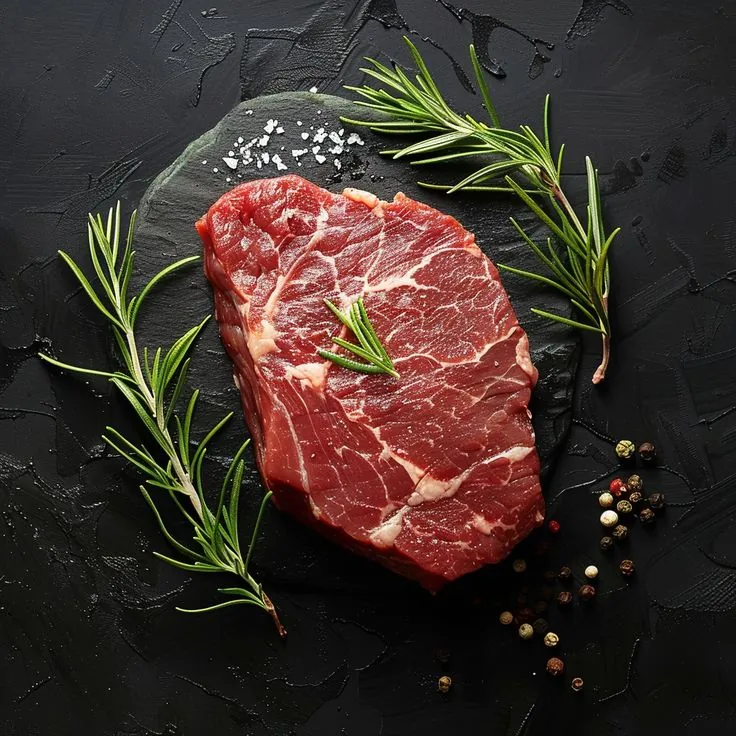
In the architecture of TCM's Five Elements, beef belongs to Earth — the element associated with the Spleen and Stomach, the digestive organs the system places at the literal centre of all life. The Spleen, in TCM physiology, is the organ that transforms food and drink into Qi and Blood. When it is strong, energy is abundant, flesh is well-toned, and the mind is clear. When it is depleted — by overwork, poor diet, cold food, or simply the relentless pace of modern life — everything downstream suffers.
Beef, with its sweet flavour and neutral-to-slightly-warming temperature, speaks directly to that centre. Sweet flavour in the TCM flavour-organ framework tonifies and nourishes — it is the taste that gently replenishes rather than stimulates or purges. Neutral temperature means beef suits most constitutions: it does not drive heat into bodies that already run warm, but it offers just enough gentle warmth to support a cold or weakened digestive centre.
This distinguishes beef clearly from lamb (羊肉, yángròu), which is markedly warming and specifically indicated for Yang deficiency patterns. Beef is more broadly tonifying — a general rebuilder rather than a targeted warming agent.
TCM profile at a glance:
- Flavour: Sweet
- Nature: Neutral (平, píng), tending slightly warming
- Organ systems entered: Spleen (脾), Stomach (胃)
- Traditional role: Traditionally included in diets aimed at tonifying the Middle Qi (补中益气), nourishing Blood (养血), and strengthening tendons and bones (强筋骨); particularly associated with recovery after illness, postpartum depletion, and physical exhaustion
A large UK dietary survey found beef to be the single greatest contributor to B12, iron, and zinc across all meat-eating groups — no single plant food matches all three in quantity or bioavailability — making it a true dà bǔ (大补), a tonic that nourishes multiple systems at once.[4]
Beef is one of the richest sources of vitamin B12, found almost exclusively in animal foods and critical for myelin synthesis, nerve signalling, and cognitive resilience.[3] This maps directly onto the TCM understanding of Kidney Essence as the foundation of a sharp mind and steady nerves.
A 100 g serving of beef supplies roughly 44–55% of the adult daily zinc requirement in a highly bioavailable form, supporting virtually every branch of cellular immunity — neutrophils, NK cells, macrophages, and lymphocytes.[5][4] In TCM, this is the nutritional basis for Wei Qi (卫气) — the defensive energy at the body's surface.
🔬 What the Research Shows
Modern nutritional science has spent decades examining what beef actually does in the human body. Three findings stand out as particularly well-supported — and all three echo what TCM has said about beef for centuries.
Beef's iron is absorbed far more efficiently than plant-based iron. Iron from animal tissue — haem iron — is absorbed at a rate of 15–35%, compared to just 2–20% for the non-haem iron found in grains, legumes, and leafy vegetables.[1] Unlike plant iron, haem iron absorption is not significantly blocked by phytates or polyphenols — meaning that what you eat alongside your beef has much less effect on how much iron you actually absorb. This makes beef a uniquely reliable dietary strategy for maintaining iron stores, particularly for premenopausal women, pregnant women, and young children — the groups at highest risk of iron-deficiency anaemia worldwide. It is a direct modern parallel to TCM's millennia-old designation of beef as a blood-nourishing (补血, bǔ xuè) food.
A modest serving of beef protein maximally stimulates muscle building — even in elderly adults. A randomised controlled trial measured muscle protein synthesis rates after subjects ate either a moderate (113 g, ~30 g protein) or large (340 g, ~90 g protein) serving of 90%-lean beef. A moderate serving stimulated muscle protein synthesis by approximately 50% above baseline in both young (average age 34) and older (average age 68) participants — and tripling the portion produced no additional benefit whatsoever.[2] This is significant for older adults, who often face reduced capacity to build muscle from a given amount of protein. Beef's complete amino acid profile — including a high leucine content, which is the primary signal for muscle synthesis — makes even a moderate serving unusually effective at doing what TCM described as "supplementing Qi and augmenting strength" (补气增力).
Beef is the body's primary dietary source of creatine — a compound that supports both physical performance and memory. Beef provides approximately 4–5 g of creatine per kilogram of raw meat, more than virtually any other food. A systematic review and meta-analysis of ten randomised controlled trials found that creatine supplementation significantly improved memory performance in healthy adults, with the most pronounced benefits appearing in older adults aged 66–76.[6] Because the brain's creatine pool is partly sustained by dietary intake — and omnivores have measurably higher brain creatine stores than vegetarians — regular beef consumption supports the kind of cognitive energy and resilience that becomes increasingly valuable with age. This modern evidence aligns with the classical TCM description of beef supplementing Essence (精) and nourishing the Marrow (髓) — understood in Chinese medicine as the substrate of brain and nerve tissue.
🥣 How to Use Beef
Beef suits both slow and quick preparations. TCM favours gentle, long-cooked methods — a broth with red dates and ginger is the classic recovery dish — but a quick stir-fry with seasonal vegetables is equally nourishing. Aim for lean, unprocessed cuts two to four times per week as part of a varied diet. For step-by-step recipes using beef, see:
- Stir-fried Beef and Asparagus – A Quick Spring Tonic
- Homemade Beef with Tofu – A Warming, Balanced TCM Dish
A Note on Quantity and Caution
A moderate serving of lean, unprocessed beef two to four times per week sits comfortably within what nutritional research considers reasonable for most healthy adults. The words lean and unprocessed carry real weight here: a slow-braised shank, a stir-fried sirloin, or a simple broth are categorically different from a processed sausage or a fast-food patty — and the evidence treats them very differently.
It is worth being honest about the cancer risk context: the International Agency for Research on Cancer (IARC) classifies unprocessed red meat as Group 2A — "probably carcinogenic to humans" — based on limited epidemiological evidence, primarily associated with high-temperature cooking methods such as grilling and frying at very high heat. Processed red meat (bacon, salami, hot dogs, cured sausages) carries a higher Group 1 classification and is best minimised. Slow-braised, gently cooked, unprocessed beef is a different proposition — but the distinction matters, and preparation method and frequency are as important as the ingredient itself.
If you have a known inflammatory or cardiovascular condition, or are managing iron overload (haemochromatosis), speak with a doctor before increasing red meat intake significantly. TCM also notes that people with clear heat signs — a tendency toward inflammation, skin redness, or easily running warm — may prefer to keep beef moderate and balance it with plenty of cooling vegetables.
As always in TCM food-medicine: steady, moderate, and varied over the long term. Not intense, not excessive, never short-term.
📚 Further Reading
There is something quietly reassuring about a tonic that does not ask you to reinvent your kitchen — only to pay a little more attention to what is already in front of you. Beef has held its place in Chinese dietary medicine for two thousand years not because of marketing or fashion, but because generations of careful practitioners watched, took notes, and noticed that it worked. The science now arriving to confirm what they observed does not make it more true; it simply adds a language our own era finds easier to trust. Slow-braise it, stir-fry it, simmer it into broth with red dates and ginger on a quiet Sunday afternoon. Let it do what it has always done — quietly, patiently, and rather beautifully.
📖 References
- Hurrell RF, Egli I. (2010). Iron bioavailability and dietary reference values. American Journal of Clinical Nutrition, 91(5), 1461S–1467S. https://doi.org/10.3945/ajcn.2010.28674F
- Symons TB, Sheffield-Moore M, Wolfe RR, Paddon-Jones D. (2009). A moderate serving of high-quality protein maximally stimulates skeletal muscle protein synthesis in young and elderly subjects. Journal of the American Dietetic Association, 109(9), 1582–1586. https://doi.org/10.1016/j.jada.2009.06.369
- O'Leary F, Samman S. (2019). Vitamin B12 Intake From Animal Foods, Biomarkers, and Health Aspects. Frontiers in Nutrition, 6, 93. https://doi.org/10.3389/fnut.2019.00093
- Sharma S, Mbanya JC, Cruickshank K, et al. (2013). Contribution of meat to vitamin B-12, iron and zinc intakes in five ethnic groups in the UK: Results from the Diet and Nutrition Survey of Adults 2000/2001. Journal of Human Nutrition and Dietetics, 26(S2), 1–12. https://doi.org/10.1111/jhn.12035
- Prasad AS. (2008). Zinc in human health: Effect of zinc on immune cells. Molecular Medicine, 14(5–6), 353–357. https://doi.org/10.2119/2008-00033.Prasad
- Forbes SC, Cordingley DM, Cornish SM, et al. (2023). Effects of creatine supplementation on memory in healthy individuals: A systematic review and meta-analysis of randomized controlled trials. Nutrition Reviews, 81(4), 416–428. https://doi.org/10.1093/nutrit/nuac064